The Great Scottish Cap Mystery: Are Tethered Bottle Lids Just Hiding Our Ocean Plastic on the Seabed?
If you’ve ever scrambled down a boggy, wind-battered headland to clean a remote Scottish cove—the sort of beach that lies a mile from the nearest single-track road and five miles from the nearest wheelie bin—you quickly notice a strange quirk in the tide line.
Every winter, the Atlantic and the North Sea hurl plastic into deep rock gullies and tangles of kelp. Casual hikers might pick up the odd whole drinks bottle and stuff it into a rucksack, yet tucked away in sheltered pockets of shingle, we find hundreds—sometimes thousands—of orphaned plastic bottle caps. They sit there in colorful drifts, accumulated over decades.
Why so many caps without their bottles? And more importantly: what happens now that drinks manufacturers have tethered the caps to the bottles?
In mid-2024, under the European Union’s Single-Use Plastics Directive (Directive EU 2019/904)—which knocked directly onto UK production lines for brands like Coca-Cola, Suntory, and Innocent—plastic drinks bottles up to three liters switched to attached (“tethered”) caps. On land, the logic is simple: keep the cap attached to the bottle so both make it to the recycling plant together.
Out at sea, however, the laws of physics take over. And if you look at the material densities and human behavior around tethered caps, a darker possibility emerges: rather than stopping marine plastic pollution, tethered caps may simply be dragging floating evidence down to the bottom of the sea.
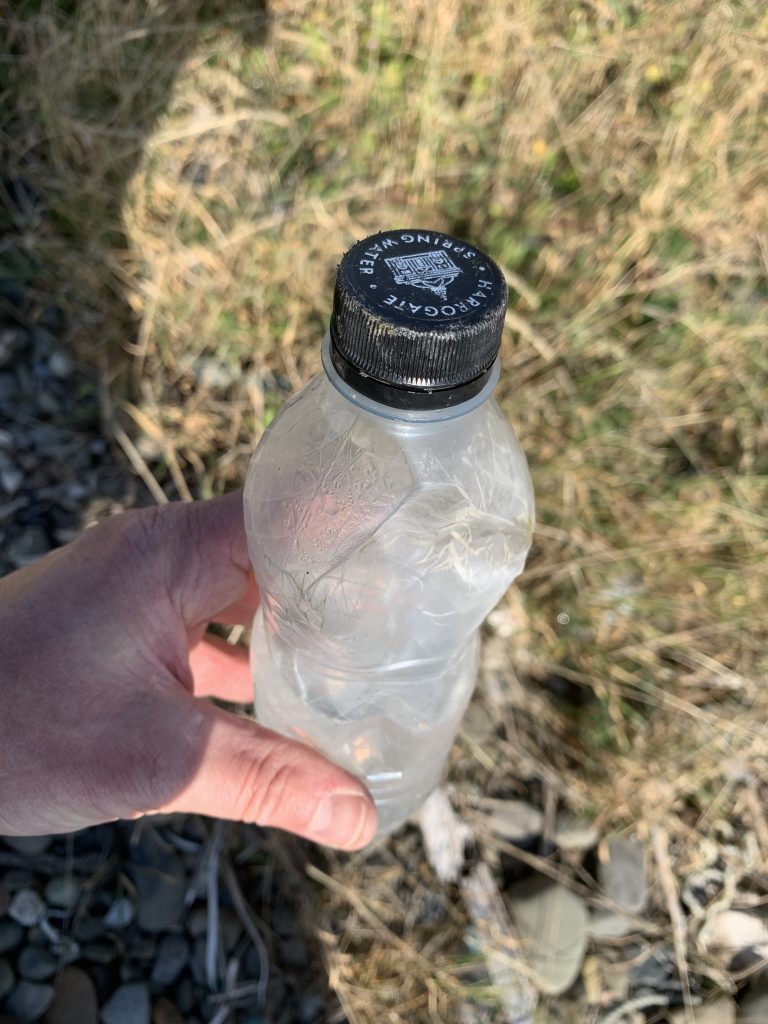
Part 1: The Physics of the Tide Line (Why Caps Float and Bottles Sink)
To understand why Scottish coves are graveyards for bottle tops, we have to look at the two very different polymers used to make a standard drinks bottle, and compare their specific gravity (density) to North Atlantic seawater (ρseawater ≈ 1.025 g/cm3):
- The Bottle Body (PET): Made of Polyethylene Terephthalate, which has a density of 1.38 g/cm3. Because it is significantly denser than seawater, flooded PET sinks.
- The Cap and Collar (HDPE or PP): Made of High-Density Polyethylene (0.95 g/cm3) or Polypropylene (0.90 g/cm3). Because both are less dense than seawater, they float.
As oceanographic researchers at The Ocean Cleanup point out, nearly half of all plastic produced globally is denser than seawater and sinks immediately upon entering the ocean unless air is trapped inside. When an uncapped bottle enters a river or falls off a ferry, the PET body fills with water and drops to the riverbed or coastal seafloor. The detached HDPE cap, meanwhile, bobs to the surface and rides wind-driven surface currents for hundreds of miles until it gets wedged in a Scottish bay.
Even when a capped bottle floats across the sea, the violent surf on rocky Scottish coasts eventually cracks the rigid PET bottle or strips the cap off, sinking the bottle offshore and tossing the cap up onto the high-water mark.
Part 2: Doing the Maths—Does a Tethered Cap Float the Bottle, or Does the Bottle Sink the Cap?
Now that the cap is tethered to the neck of the bottle, we have created a composite object—part float, part anchor. If a bottle enters the sea without its lid screwed down air-tight, who wins the tug-of-war?
According to Archimedes’ Principle, an object in seawater experiences an upward buoyant force equal to the weight of the seawater it displaces:
Net Buoyancy (g-force) = (Vtotal × ρseawater) − Mtotal
Where:
- ρseawater = 1.025 g/cm3
- ρPET = 1.38 g/cm3
- ρHDPE = 0.95 g/cm3
Let’s run the numbers across three real-world beverage scenarios when the tethered cap is left open (meaning the bottle fills completely with water).
Scenario A: Standard 500 ml Carbonated Bottle (e.g., Coca-Cola)
A modern 500 ml carbonated PET bottle needs thicker walls to hold pressure, weighing roughly 21.0 g, paired with a lightweight 2.2 g tethered HDPE screw cap (28 mm neck).
- PET Bottle Volume: 21.0 g ÷ 1.38 g/cm3 = 15.22 cm3
- PET Buoyant Force: (15.22 cm3 × 1.025 g/cm3) − 21.0 g = −5.40 g (Sinking force)
- HDPE Cap Volume: 2.2 g ÷ 0.95 g/cm3 = 2.32 cm3
- HDPE Cap Buoyant Force: (2.32 cm3 × 1.025 g/cm3) − 2.2 g = +0.17 g (Upward lift)
- Net Assembly Balance: −5.40 g + 0.17 g = −5.23 g
- Combined Effective Density: 23.2 g ÷ 17.54 cm3 = 1.32 g/cm3
Verdict: The tiny +0.17 g upward lift of the Coca-Cola cap is thirty times too weak to hold up the PET bottle. The bottle drags the cap straight to the seabed. To make this bottle float, it would need at least 5.1 ml of trapped air inside.
Scenario B: Wide-Mouth 330 ml Smoothie or Juice Bottle (Large Lid)
What about a juice or smoothie bottle (like an Innocent smoothie or wide-mouth juice bottle) where the bottle is smaller, and the lid is a chunky 38 mm wide-mouth HDPE cap? Here, the PET body weighs around 18.5 g, while the heavy, wide HDPE cap and tether ring weigh roughly 4.2 g.
- PET Bottle Volume: 18.5 g ÷ 1.38 g/cm3 = 13.41 cm3
- PET Buoyant Force: (13.41 cm3 × 1.025 g/cm3) − 18.5 g = −4.76 g (Sinking force)
- Large HDPE Cap Volume: 4.2 g ÷ 0.95 g/cm3 = 4.42 cm3
- Large HDPE Cap Buoyant Force: (4.42 cm3 × 1.025 g/cm3) − 4.2 g = +0.33 g (Upward lift)
- Net Assembly Balance: −4.76 g + 0.33 g = −4.43 g
- Combined Effective Density: 22.7 g ÷ 17.83 cm3 = 1.27 g/cm3
Verdict: Even doubling the size of the lid barely makes a dent in the physics. Because HDPE (0.95 g/cm3) is only marginally less dense than seawater (1.025 g/cm3), every gram of HDPE cap only provides about 0.079 g of net upward lift. To float an 18.5 g PET juice bottle using solid HDPE plastic alone, the cap would need to weigh an absurd 60 grams—more than three times the weight of the bottle itself!
Scenario C: Ultra-Light 500 ml Still Water Bottle
Even if we take the lightest “eco-weight” still water bottle on the market—just 10.5 g of PET with a 1.8 g cap:
- PET Sinking Force: −2.70 g
- Cap Upward Lift: +0.14 g
- Net Assembly Balance: −2.56 g (Effective density: 1.27 g/cm3 — Still sinks!)
| Bottle Type | PET Body Mass | HDPE Cap Mass | Cap Lift Force | Bottle Sink Force | Net Force (Uncapped/Open) | Float or Sink? |
|---|---|---|---|---|---|---|
| 500 ml Cola Bottle | 21.0 g | 2.2 g | +0.17 g | −5.40 g | −5.23 g | Sinks rapidly |
| 330 ml Wide-Lid Juice | 18.5 g | 4.2 g | +0.33 g | −4.76 g | −4.43 g | Sinks rapidly |
| 500 ml Eco Water | 10.5 g | 1.8 g | +0.14 g | −2.70 g | −2.56 g | Sinks |
| Any Bottle (Screwed Tight) | 21.0 g | 2.2 g | +0.17 g | +507.1 g (with air) | +507.3 g | Floats high |
Part 3: The Behavioral Twist—Are People Leaving Tethered Caps Unscrewed?
This brings us to the human factor. A PET bottle only floats if its cap is screwed back on tightly enough to trap at least 3 to 6 ml of air inside.
Before tethered caps were introduced, a person finishing a drink had two distinct pieces of plastic in their hands. Even someone carelessly tossing a bottle into an overflowing bin—or dropping it on a windy ferry deck—often screwed the cap back on out of pure muscle memory, neatness, or to stop sticky dregs from dripping. If that sealed bottle blew into the sea, it floated ashore whole, where beach cleaners could pick up both the bottle and the cap.
Has tethering changed whether people screw the lid back on? Consumer and industry ergonomics studies suggest it has:
- The “Hinge Friction” Problem: Early consumer usability studies reported by Packaging Europe and closure manufacturer Sidel found that consumers frequently struggled with the mechanics of tethered screw and sport caps. Because tethered caps are engineered with a cam-hinge that “clicks” into a locked-open position (to stop the cap hitting your nose while drinking), closing the bottle requires pushing the cap back over the hinge resistance and aligning the threads at an awkward angle.
- Post-Implementation Consumer Backlash: A longitudinal study examining consumer interactions with tethered caps between 2024 and 2025 (Mandatory Tethered Caps on Plastic Beverage Bottles: Consumer Perception and Acceptance Pre- and Post-Implementation of the EU Single-Use Plastic Directive) found that consumer sentiment actually grew more negative after the rollout, driven by ergonomic frustration and difficulty re-closing the caps cleanly.
- The “Half-Torn” Effect: Walk down any high street today and look in a public litter bin. You will see dozens of bottles where the drinker—annoyed by the cap brushing their cheek—has yanked one of the two plastic tether straps until it snapped. Once one strap is stretched or torn, the cap sits crookedly on the neck, making it almost impossible to screw back down to an airtight seal. Instead, people simply flip the cap loosely over the opening and toss the bottle away.
Part 4: Out of Sight, Out of Mind? The Benthic Plastic Sink
What happens when a bottle with a flipped-open or crookedly-tethered cap enters the sea?
Water floods the neck, the air escapes, and—as our maths proved—the PET bottle acts as a deadweight anchor, dragging the buoyant HDPE cap down to the seafloor with it.
Oceanographers and marine charities have long warned that beach litter is only the tip of the iceberg:
- UNEP (United Nations Environment Programme) and marine litter researchers (such as Andrady, 2011, and Woodall et al., 2014, published in Royal Society Open Science) estimate that roughly 70% of marine plastic debris eventually sinks to the seabed (the benthic zone), while only 15% floats on the surface and 15% washes ashore on beaches.
- For over two decades, the Marine Conservation Society’s (MCS) Beachwatch surveys and Surfers Against Sewage reports have ranked plastic bottle caps and lids among the top two or three most common items found on UK beaches. Those floating caps served as a crucial “canary in the coal mine”—a visible, countable indicator of how many drinks containers were leaking into our seas.
If tethered caps mean that fewer caps detach, and simultaneously mean that fewer littered bottles are screwed airtight, we create a perverse statistical illusion:
- Scenario 1 (The Genuine Win): A conscientious consumer leaves the cap attached and puts the bottle in a recycling bin. Neither cap nor bottle enters the sea.
- Scenario 2 (The Hidden Loss): A littered or wind-blown bottle enters the sea with its tethered cap flipped open. Instead of the bottle floating ashore (as it would have if screwed shut) or the cap floating ashore into a Scottish cove (as it would have if detached), both sink out of sight to the cold, dark seafloor.
Once on the seabed, deprived of UV sunlight and warm temperatures, a PET bottle and its HDPE cap can take 400 to 500 years to fragment into benthic microplastics—completely beyond the reach of volunteer beach cleaners.
The Takeaway from the Tide Line
Next time you are out on a remote Scottish beach clean, keep an eye on the caps you pull from the seaweed. Right now, we are still picking up the “legacy drift”—caps manufactured in the 1990s, 2000s, and 2010s that are still washing in from the North Atlantic gyre.
Over the next decade, beachwatch surveys may well celebrate a drop in loose bottle caps washing up on UK shores. When that happens, we should ask a tough scientific question: Did we actually stop those bottles from entering the ocean—or did we just tether the float to the anchor and sink the evidence?
Leave a Reply